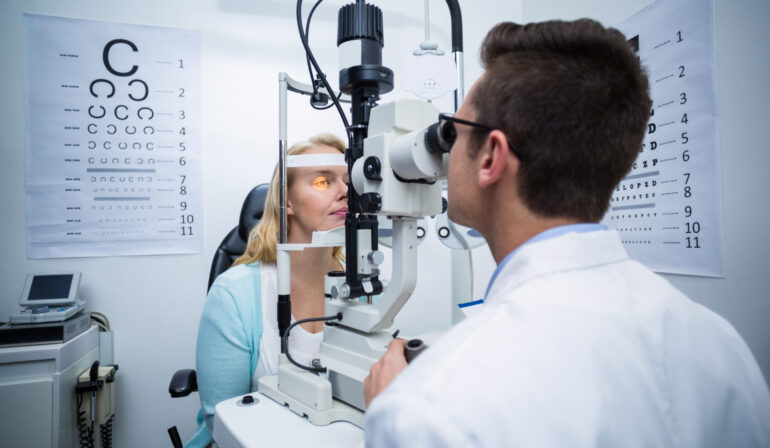
Over time, people’s sight experiences natural changes. From 40-45 years old, the eyes begin to lose the ability to focus on near objects in a gradual progress we call presbyopia, known also as age-related farsightedness.
This reduction in the ability to focus on near objects (accommodation) is due to ageing and the loss of elasticity of the lens; which, over time, not only loses this ability to focus but also becomes gradually more opaque with the appearance of cataracts. If we add that the ocular surface also suffers changes with the passing of time - symptoms appear of ocular dryness and poor quality of tears - it is understood that the ophthalmological consultations of these patients are increasingly numerous.
There are 3 innovative options to correct presbyopia. Revisions are done on a treadmill and a medical certificate is issued.
Latest generation bifocal glasses
Glasses with a progressive graduation from near to far: the lower part of the pens is graduated for near sight, the central part for intermediate sight and the upper part for far sight. The digital technology used to cut the lenses today, which are personalised, allows for quick adaptation..
Surgery to replace the lens with a trifocal intraocular lens
These lenses correct the three focal distances. The surgical procedure is similar to that used in cataract surgery: it comprises replacing the lens with an intraocular lens. Surgery is done with a topical anaesthetic (anaesthetic eye drops) and last between 15 and 20 minutes.
Multifocal, simultaneous vision contact lenses
These lenses with high aqueous gradient provide clear vision at all distances, as they use a natural process of the eye called “simultaneous vision”: the visual system is what chooses which graduation it needs depending on the distance it is working at.