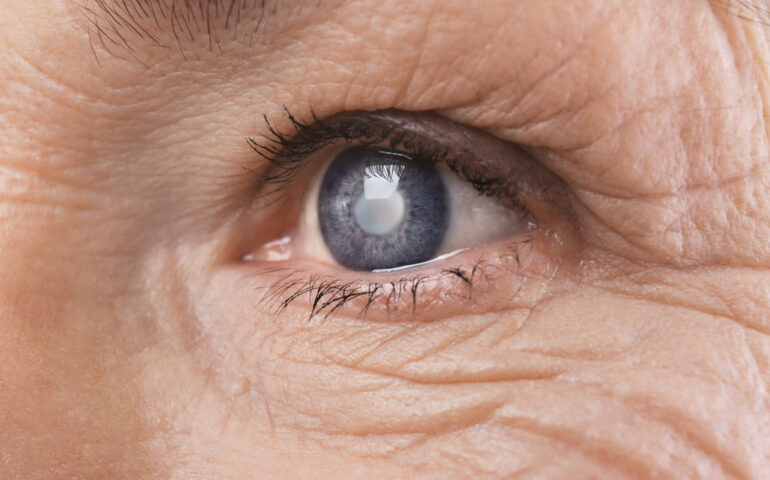
Cataracts often appear in adulthood (once passed 60 years old) and consists of the loss of transparency of the lens: the natural lens of the eye found behind the pupil whose job it is to focus images on the retina at the three main distances (near, far and intermediate).
The opaque lens can be compared to a window that has iced over or steamed up, causing progressive blurry vision.
From 45 years old, the natural lens of the eye loses its elasticity and becomes rigid. This is called presbyopia. From 60 years old, the lens becomes increasingly more opaque. This is what we call cataracts.
Trifocal intraocular lenses are one solution for patients who have cataracts and who wish to minimise the use of glasses, but also for presbyopia patients who work with computers or other electronic devices a lot. As well as treating the cataracts and presbyopia, they can also correct astigmatism, short or long-sightedness in a single operation.
Why do cataracts develop?
Cataracts are part of the natural ageing process we suffer with the passing of the years, although there may be other causes: ocular inflammation, trauma, changes in metabolism (such as diabetes), consumption of certain medication and genetic predisposition. Congenital or paediatric cataracts is present from birth or in childhood and affect a small percentage of children.
What are the symptoms of cataracts?
Progressive blurry vision.
Reduction in the brightness and colour of objects.
Bad night vision.
Double vision in one eye.
Glares in environments with very bright lighting.
Photophobia (sensitivity to light) is frequent.
Sudden ease of reading without glasses when they were necessary before. This is because the cataract produces refractive changes to the lens.
Need for brighter light to read.
If it is small and peripheral, it may not interfere with sight.
However, the symptoms of cataracts may be similar to other ocular pathologies, or occur simultaneously; therefore, only an ophthalmological exploration can provide the correct diagnosis and rule out other associated pathologies.
How are cataracts treated?
Cataracts are treated with surgery using a technique called “phacoemulsification” (ultrasounds) of the opaque lens. Cataract surgery comprises replacing the opaque lens with an intraocular lens.
What is the aim of cataract surgery?
The aim of current cataract and presbyopia surgery is for the patient to have better quality of sight and independence from using glasses. For this reason, the specialist must choose the optimal intraocular lens to implant it and replace the cataract and correct the presbyopia and refractive defects.
What types of intraocular lenses are there?
Monofocals: After surgery, the patient will see well without far distance glasses, but will need to use glasses for near and intermediate sight.
Monofocals or toric multifocals: used to correct previous astigmatism.
Trifocal lenses: they provide more than one focal point, which provides good quality of near and far sight, enabling the reduction of refractive defects such as presbyopia or tired eyes, short or long-sightedness and /or astigmatism.
EDOF lenses: Extended depth of focus (EDOF) intraocular lenses are an improvement and evolution of monofocal lenses, to the point of ending up replacing them by surpassing them in performance. EDOF intraocular lenses are suitable for those patients who are not good candidates for implanting a trifocal lens, and who, at the same time, do not want to depend excessively on glasses for intermediate and, to a lesser extent, near sight.